
Solution / 05
Change without operational drift
Cloud & application modernization
We modernize the parts that constrain the business while keeping the parts that still work—using measured migration instead of transformation theatre.
- Architecture and readiness assessment
- Application and data modernization
- Platform engineering and operations
In one answer
What is cloud & application modernization?
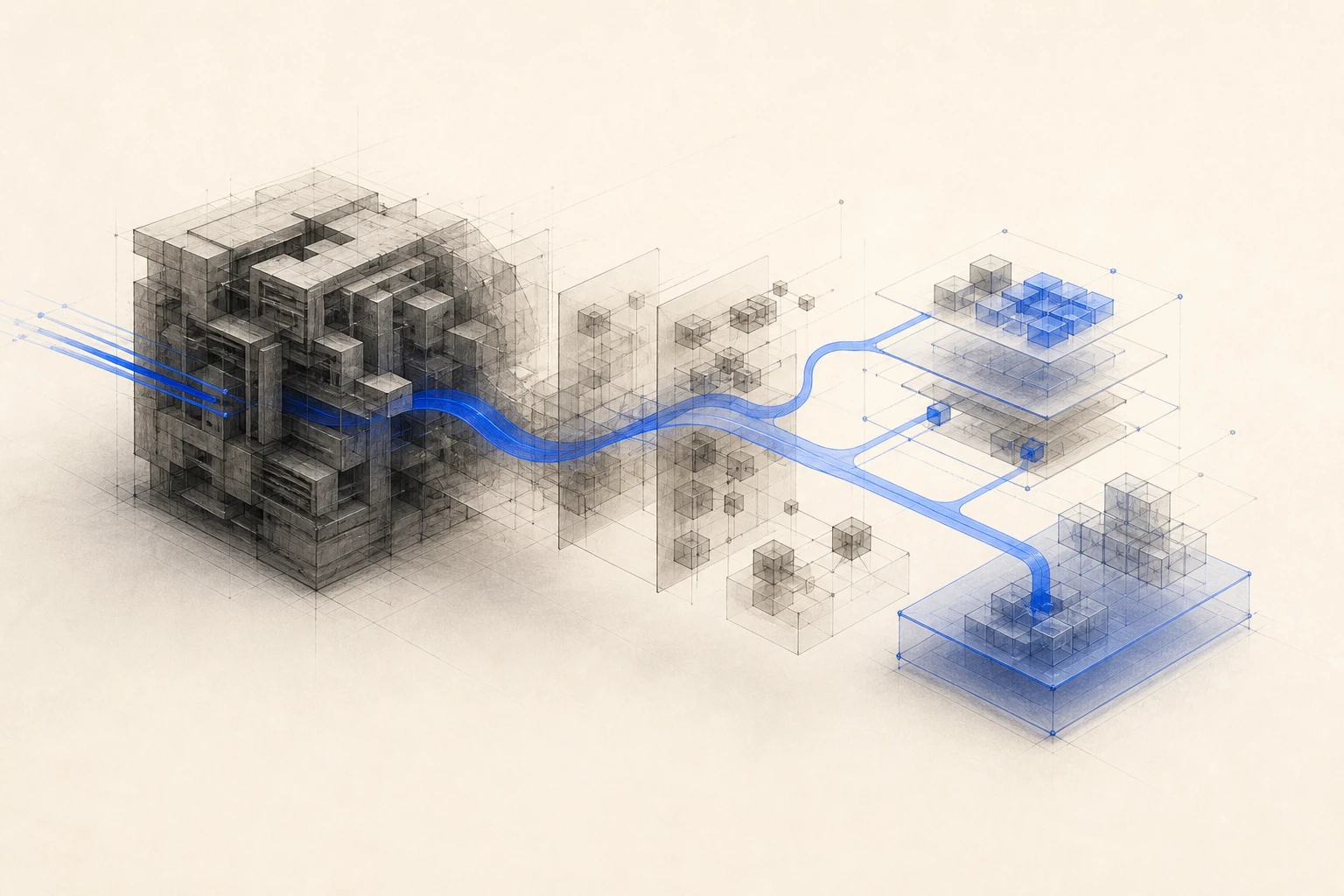
Cloud and application modernization is the selective redesign of software, data, delivery, and operational foundations so a system can change safely. It may involve re-platforming, refactoring, decomposing, replacing, or retaining components; the correct path is determined by evidence, risk, and the operating model rather than a blanket move to cloud services.
When it fits
The problem usually looks like this.
Delivery has slowed around a critical application
Changes take too long because architecture, environments, testing, and release ownership are tightly coupled.
Infrastructure risk is becoming business risk
Unsupported runtimes, manual recovery, limited telemetry, or concentrated knowledge threaten continuity.
A migration mandate lacks a safe sequence
The destination is known, but dependencies, data movement, rollback, and acceptance criteria are not yet explicit.
Cloud spend is rising without better operation
Resources moved, but architecture, automation, observability, and ownership did not mature with them.
What the engagement produces
A working system.
Not a strategy deck.
Modernization decision map
A component-level view of what to retain, re-platform, refactor, replace, or retire—and why.
Migration architecture
Target boundaries, dependency sequence, data transition, compatibility, rollback, and cutover controls.
Modern delivery foundation
Automated environments, deployment, tests, observability, security controls, and developer workflows.
Operational transition
Reliability objectives, dashboards, runbooks, ownership, and staged decommissioning backed by production evidence.
Delivery path
One accountable path from constraint to operation.
- 01Assess
Measure the constraint
Combine architecture, operational behaviour, delivery flow, cost, and business criticality into one baseline.
- 02Architect
Choose the smallest safe change
Design target boundaries and a transition sequence that can deliver value before the entire program is complete.
- 03Integrate
Migrate through controlled increments
Use compatibility layers, automated validation, observability, and rollback to protect continuity.
- 04Operate
Retire risk with evidence
Compare production behaviour to the baseline, transfer ownership, and remove legacy components only when safe.
Direct answers
Questions worth resolving early.
01Does modernization always mean rewriting the application?
No. A rewrite is only one option and often the riskiest. Retaining, re-platforming, isolating, or incrementally replacing specific components may deliver the outcome with less disruption.
02Can modernization happen without a big-bang migration?
Yes. We prefer staged transitions with explicit compatibility, data synchronization, validation, and rollback paths when the system and business constraints allow them.
03How do you protect operational continuity?
We define service objectives and critical workflows first, instrument both old and new paths, automate validation, rehearse recovery, and move traffic or responsibility in measurable increments.
04Do you optimize cloud cost as part of the work?
Yes, where cloud is in scope. Cost is treated as an architectural and operational signal alongside reliability, performance, security, and delivery speed.