
Solution / 06
Software that reaches the physical world
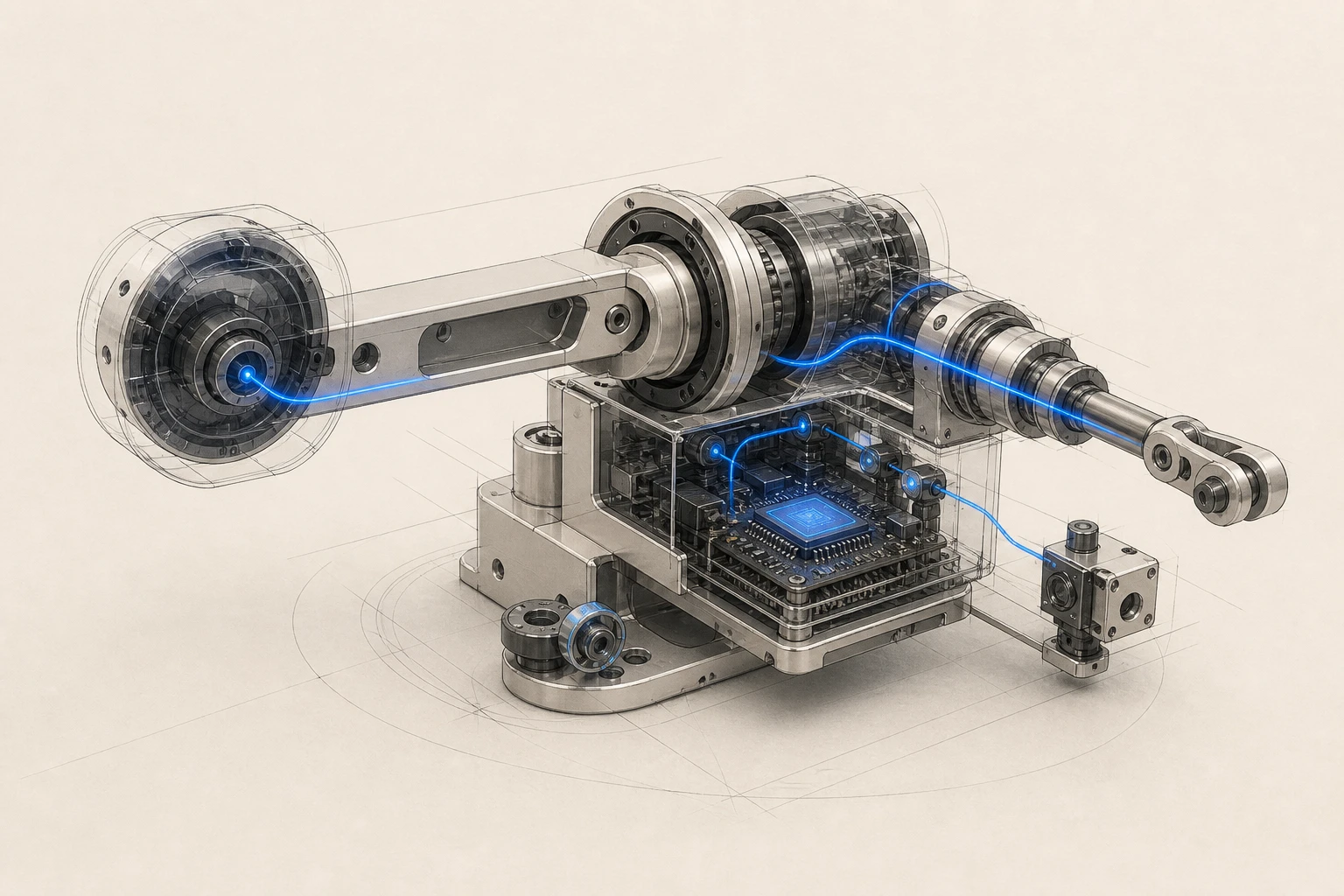
Connected products & robotics
We engineer the complete path from sensing to decision to motion—and the software required to understand that system once it leaves the lab.
- Edge and embedded architecture
- Control, sensing, and real-time software
- Telemetry and fleet operations
In one answer
What is connected products & robotics?
Connected product and robotics engineering brings embedded software, sensing, real-time control, edge intelligence, communications, cloud services, and operational tooling into one coherent system. The work spans physical constraints and software boundaries so behaviour can be tested, observed, updated, and supported in the field.
When it fits
The problem usually looks like this.
A prototype must become a dependable product
The core behaviour works, but hardware variation, timing, updates, diagnostics, and field support still need production engineering.
Intelligence must run near the machine
Latency, connectivity, privacy, power, or resilience requires decisions to happen at the edge rather than only in the cloud.
Software and hardware teams are drifting apart
Interfaces, timing assumptions, ownership, and test environments need to become one shared engineering model.
Field behaviour is difficult to explain
Operators need telemetry, diagnostics, update control, and traceable state to maintain a distributed physical system.
What the engagement produces
A working system.
Not a strategy deck.
Embedded and control architecture
Task boundaries, timing, sensing, actuation, state, safety constraints, communication, and failure behaviour.
Edge intelligence
On-device inference, signal processing, decision logic, local storage, and degraded or offline operation.
Connected product platform
Provisioning, identity, secure communication, telemetry, remote configuration, and controlled software updates.
Verification and field tooling
Simulation, hardware-in-the-loop tests, diagnostics, fleet visibility, release evidence, and operational runbooks.
Delivery path
One accountable path from constraint to operation.
- 01Assess
Define physical constraints
Capture timing, energy, compute, environment, connectivity, failure, and human interaction requirements.
- 02Architect
Partition the system
Place sensing, control, intelligence, communication, and cloud responsibility where each can remain dependable.
- 03Integrate
Test reality early
Connect simulation, benches, representative hardware, and end-to-end telemetry before field behaviour becomes expensive.
- 04Operate
Engineer the fleet lifecycle
Make identity, diagnostics, updates, incidents, and hardware variation visible across deployed systems.
Direct answers
Questions worth resolving early.
01Do you work on both embedded software and cloud services?
Yes. Connected systems are treated end to end: device software, control, communications, backend services, operational interfaces, data paths, and update mechanisms are designed as related boundaries.
02Can AI inference run directly on the device?
Yes, when the model fits the latency, compute, memory, power, thermal, and update constraints. We evaluate the full system trade-off rather than assuming cloud or edge by default.
03How do you test robotics before field deployment?
The test strategy can combine simulation, recorded sensor data, software-in-the-loop, hardware-in-the-loop, bench tests, fault injection, acceptance scenarios, and staged field operation.
04Can you take an existing prototype toward production?
Yes. We first assess architecture, hardware assumptions, timing, failure behaviour, build reproducibility, diagnostics, and ownership, then define the smallest sequence that retires the highest production risks.