
Solution / 07
Trust made enforceable
Security engineering & cyber resilience
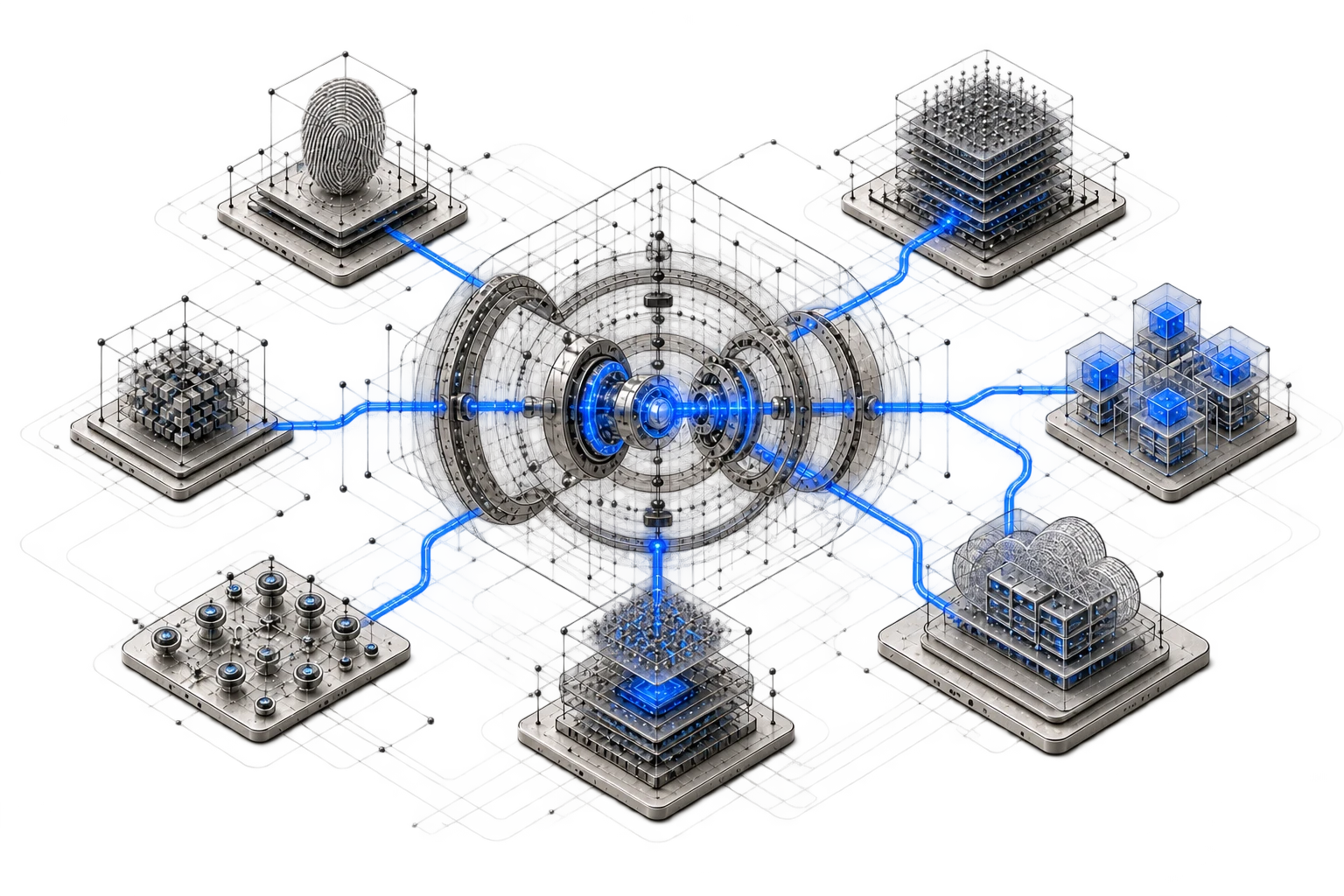
We make trust explicit across identities, applications, agents, infrastructure, and devices—then connect those controls to evidence and recovery.
- Zero Trust and identity architecture
- Application, cloud, and AI security
- Detection, incident readiness, and resilience
In one answer
What is security engineering & cyber resilience?
Security engineering turns business risk and realistic threat scenarios into enforceable system boundaries. It combines identity and workload access, application and cloud controls, AI and agent security, data protection, secure delivery, detection, and incident readiness so protection remains part of architecture and operation rather than a review performed at the end.
When it fits
The problem usually looks like this.
Identity and access have fragmented across the estate
People, workloads, service accounts, devices, and agents need one explicit model for authentication, authorization, privilege, and review.
AI systems can reach sensitive tools and data
Model behaviour, prompts, retrieval, tool calls, memory, and non-human identities need controls that assume inputs and outputs may be hostile.
Modernization is changing the threat boundary
Cloud, APIs, platforms, and connected products are moving faster than the controls, ownership, and operational evidence around them.
An incident would be difficult to explain or contain
Telemetry, detection logic, isolation paths, recovery decisions, and evidence need to be designed before the moment they are required.
What the engagement produces
A working system.
Not a strategy deck.
Threat and trust architecture
Critical assets, abuse paths, identities, trust boundaries, control objectives, and residual risk mapped to the actual system.
Identity and enforcement layer
Human, workload, agent, and device identity with least-privilege policy, secrets boundaries, segmentation, and auditable decisions.
Secure product and delivery controls
Application, API, cloud, AI, and supply-chain controls integrated with design, code, build, deployment, and change review.
Detection and resilience system
Security telemetry, detection hypotheses, triage paths, containment, recovery exercises, and operational ownership tied to evidence.
Delivery path
One accountable path from constraint to operation.
- 01Assess
Model what can go wrong
Connect business impact, critical assets, actors, abuse paths, existing controls, and operational constraints into one threat model.
- 02Architect
Make trust explicit
Define identity, policy, segmentation, data, cryptographic, and recovery boundaries with clear ownership and exceptions.
- 03Integrate
Put controls in the path
Implement protection and evidence in applications, agents, infrastructure, devices, delivery pipelines, and operator workflows.
- 04Operate
Test detection and recovery
Exercise credible scenarios, measure control behaviour, close visibility gaps, and evolve the system from incidents and change.
Direct answers
Questions worth resolving early.
01Is this a penetration testing service?
It can include scoped adversarial validation, but the solution is broader: threat modelling, architecture, implementation, evidence, detection, and recovery. Where an independent test or certification is required, that independence should be preserved through a qualified third party.
02Can you secure AI agents and model applications?
Yes. We address agent and workload identity, tool permissions, data boundaries, prompt and retrieval threats, untrusted model output, secrets, sandboxing, human approval, evaluation, telemetry, and containment as one system.
03Do you provide a 24/7 managed SOC?
Not as a default claim. We can engineer telemetry, detections, incident workflows, integrations, and the operating model for an internal or external SOC or MDR provider. Any ongoing coverage and service level is defined explicitly in the engagement.
04Does the work guarantee compliance?
No engineering provider should imply that. We can map technical controls and evidence to agreed requirements, but legal interpretation, formal audit, and certification remain with the appropriate legal and independent assurance parties.