
Solution / 02
Context that systems can trust
Data & knowledge platforms
We turn fragmented information into governed, reusable context that people, software, models, and agents can use without losing provenance or ownership.
- Data products and pipelines
- Knowledge and retrieval systems
- Governance, lineage, and quality
In one answer
What is data & knowledge platforms?
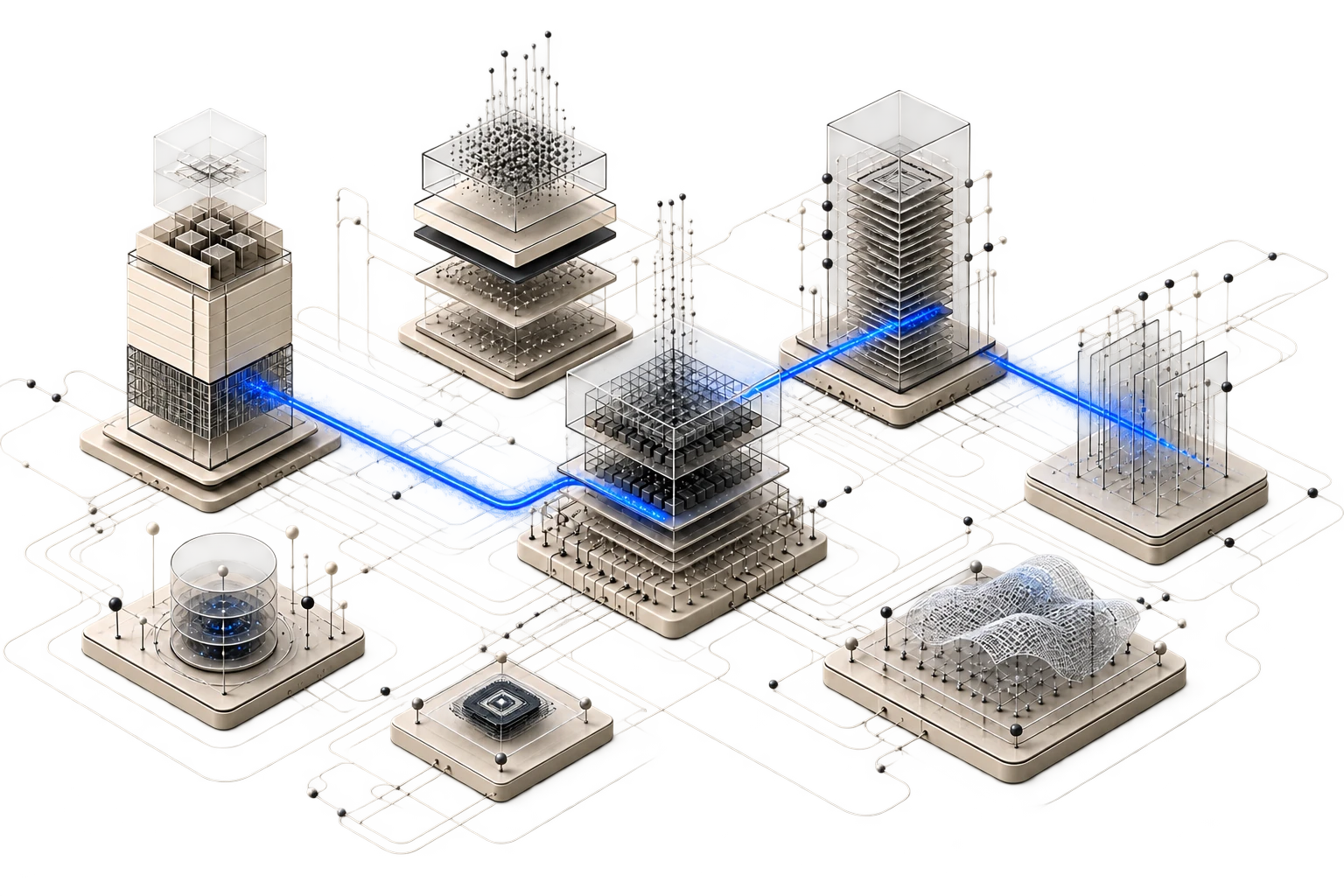
A data and knowledge platform connects operational data, documents, domain meaning, retrieval, quality controls, and delivery interfaces into a product that other systems can depend on. The work goes beyond moving records: it defines ownership, provenance, freshness, access, evaluation, and how context is served to analytics, applications, and AI workloads.
When it fits
The problem usually looks like this.
AI initiatives cannot find trustworthy context
Documents and operational data exist, but access, meaning, freshness, and provenance are inconsistent across the workflow.
Pipelines move data without creating ownership
Teams inherit brittle integrations and duplicated transformations with no clear contract for quality or change.
Retrieval works in a demo but not under evaluation
Chunking, indexing, permissions, citation, and failure behaviour need task-level evidence before production use.
Knowledge must serve people and agents together
The same corpus needs legible human interfaces, machine-readable access, and controls that remain consistent across both.
What the engagement produces
A working system.
Not a strategy deck.
Domain and data product architecture
A map of sources, ownership, contracts, transformations, quality expectations, access boundaries, and consumers.
Knowledge and retrieval system
Ingestion, indexing, retrieval, citations, permissions, and evaluation designed around the actual information task.
Governance and observability controls
Lineage, freshness, quality signals, access evidence, failure handling, and operational ownership built into delivery.
Reusable delivery interfaces
APIs, events, data products, MCP surfaces, and documentation that make context available without duplicating platform logic.
Delivery path
One accountable path from constraint to operation.
- 01Assess
Trace the information decision
Start from the user or system decision, then identify the sources, gaps, owners, and risk around its context.
- 02Architect
Define products and contracts
Separate source, transformation, knowledge, retrieval, and serving responsibilities with explicit quality boundaries.
- 03Integrate
Prove one end-to-end context path
Connect a representative workload and measure relevance, provenance, access behaviour, freshness, latency, and cost.
- 04Operate
Turn failures into platform signals
Monitor data and retrieval quality, capture feedback, preserve lineage, and make ownership actionable after launch.
Direct answers
Questions worth resolving early.
01Is this the same as building a data warehouse?
Not necessarily. A warehouse may be one component, but the solution is defined by the information products, knowledge interfaces, quality contracts, and operational consumers required by the workload.
02Do you build retrieval-augmented generation systems?
Yes, when retrieval is the right architecture. We evaluate source coverage, permissions, retrieval relevance, citation behaviour, answer quality, latency, and cost rather than treating vector search as sufficient evidence.
03Can the platform remain private or on-premise?
Yes, when the selected storage, model, and retrieval components support the required boundary. Data movement and observability are designed around that deployment decision.
04Can the same knowledge surface serve employees and agents?
Yes. Human navigation and machine access can share the same governed corpus while exposing different interfaces, permissions, and interaction patterns.